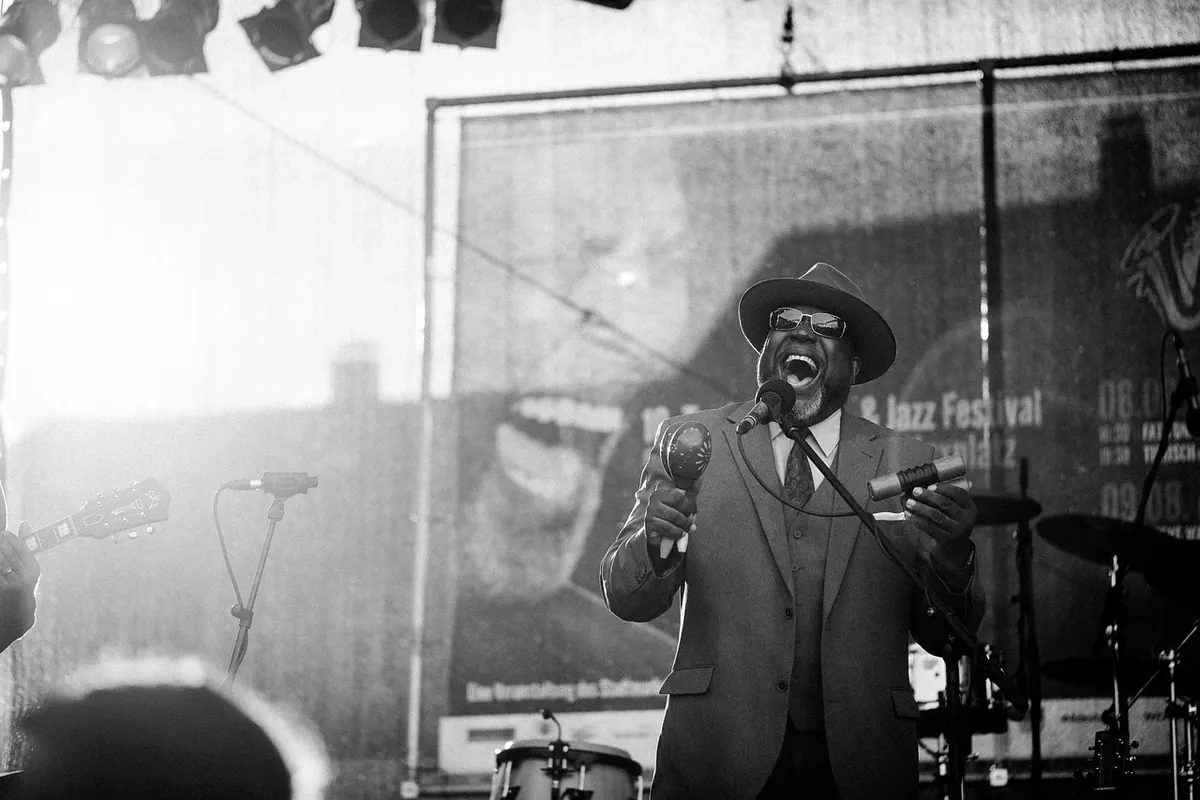
Your poems have lived on the page for months. Now you are going to stand up in a room full of strangers and say them out loud. That gap between page and voice is where most first-time readers come unstuck, and it has very little to do with whether the poem is any good. It is a craft in itself, and like any craft it can be practised.
What follows is the practical stuff: what to bring, how to hold yourself together, how to use the microphone without wrestling it, and how long you should actually be on stage.
An open mic audience is not a silent reading room. People are drinking, shifting in their seats, arriving late and glancing at the door. A poem that works beautifully on the page because of its dense, nested syntax can collapse entirely when read aloud over the hum of a bar.
For a first reading, favour poems with a clear spine: strong rhythm, vivid images, a turn you can feel coming. Two short poems will land better than one long one. If a piece needs a paragraph of explanation before it makes sense, save it for a quieter evening.
Read your chosen poems out loud at home, several times, before you commit to them. You will often discover on the third reading that a poem you love on paper is a slog in the mouth.
Nobody in the audience cares whether you read from paper or from memory. What they notice is whether you look comfortable. Set yourself up to look comfortable.
Shaking hands are much more visible when they are holding a single sheet of paper. A folder gives you something solid to hold onto.
Nerves are not a sign that you are unprepared. They are your body getting ready. The trick is not to eliminate them but to stop them taking over the steering wheel.
Arrive early. Sign up for the list, find a seat, and watch two or three other readers before you. Familiarity drains a surprising amount of fear out of a room. When your name is called, walk up slowly. There is no rush, and nobody is timing your walk.
Before you speak, put both feet flat on the floor and breathe out for longer than you breathe in. A long exhale steadies the voice far more reliably than a deep, dramatic inhale. If your hands are unsteady, rest the folder on the music stand, or hold it against your body rather than out in front of you.
A drink to settle the nerves usually does the opposite. A shaky voice plus a foggy head is a poor combination for a first reading. Save the celebration for afterwards.
Almost everyone reads too fast the first time. Adrenaline compresses time; what feels like a leisurely delivery to you will sound brisk to the audience, who are hearing every word for the first time.
Aim to read noticeably slower than feels natural. Pause at the end of every line, even when the sentence runs on — that pause is doing work the punctuation cannot do. Between stanzas, count silently to two. At the end of the poem, hold still for a beat before you say thank you. Letting the last line sit in the room is the single most effective thing a reader can do.
If you feel yourself speeding up, that is not a sign the audience is bored. It is a sign you are nervous. Slow down again.
Adjust the stand before you start, then leave it alone. Fiddling with the height mid-poem is distracting and makes a noise the audience will hear.
Speak across the microphone rather than straight into it, with your mouth roughly a hand-span away and slightly off to one side. This softens the hard popping sound that comes with words beginning with p and b. Never tap the microphone to test it; ask the room a simple question instead, such as whether you can be heard at the back.
Keep your pages down and to the side so they do not rustle against the grille. If feedback suddenly appears, step back rather than forward. And if the mic cuts out entirely, carry on without it — project to the back wall and keep going. Most rooms will meet you halfway.
Find out your slot length before the night, not during it. Open mics commonly offer three to five minutes, and many sign-up sheets state the limit. Rehearse with a timer while standing up, because reading aloud takes longer than reading in your head.
Decide your running order in advance. Open with something short and confident to settle yourself, then move to the piece you care most about. Finish with your strongest poem, not your longest one. If you are running short of time, know which stanza you would cut — deciding in the moment rarely goes well. Overrunning your slot is the quickest way to annoy a host who has twelve other poets waiting.
The first reading is the hardest. The second is easier, and by the fourth you will wonder what the fuss was about. Your poems already know how to behave on the page. Give them a few rehearsals out loud and they will behave just as well in a room.
Photo: SeppH / Pixabay

A practical guide to finding, vetting and getting the most from UK writing groups, critique circles and open mic...
Everything you need to plan a spoken-word evening: choosing a venue, building a running order, timing the stories,...

A practical checklist for punctuating dialogue in British English — quotation marks, commas, dashes and dialogue...

A hive of stories and creative inspiration.
